
UNEP FI's sustainability framework now recognizes animals as affected parties
A major update to UNEP FI’s sustainability methodologies gives animal-related impacts a more visible place in sustainability and impact assessment.
Sector Impact Matrix: https://www.unepfi.org/sector-impact-matrix/
Impact Radar: https://www.unepfi.org/publications/impact-radar-2026/
Public consultation now open
UNEP FI is currently seeking feedback on the updated Sector Impact Matrix as it continues refining the methodology. The consultation provides an opportunity for stakeholders to review the framework and share input on its approach to identifying sustainability impacts, including impacts affecting animals.
-----
In July 2026, the United Nations Environment Programme Finance Initiative (UNEP FI) released the 2026 edition of its Sector Impact Matrix, formally recognizing animals as affected parties within its sustainability impact identification methodology. For the first time, animals are included alongside other parties that can experience the positive or negative effects of economic activity.
The change extends beyond the Sector Impact Matrix. UNEP FI's 2026 Impact Radar also introduces animal welfare as a standalone sustainability topic.
UNEP FI's sustainability methodologies include two complementary resources. The Impact Radar provides the sustainability topics and affected parties that make up UNEP FI's impact framework, while the Sector Impact Matrix applies that framework to specific economic sectors and industries. In other words, the Radar defines what sustainability issues are considered, and the Matrix helps identify where those impacts are most likely to occur.
Humane World for Animals participated in UNEP FI's peer review process and is recognized by UNEP FI as a source of expert input during development of the updated methodologies.
For the FARMS Initiative, this represents an important step toward bringing animal welfare into mainstream sustainability and sustainable finance discussions.
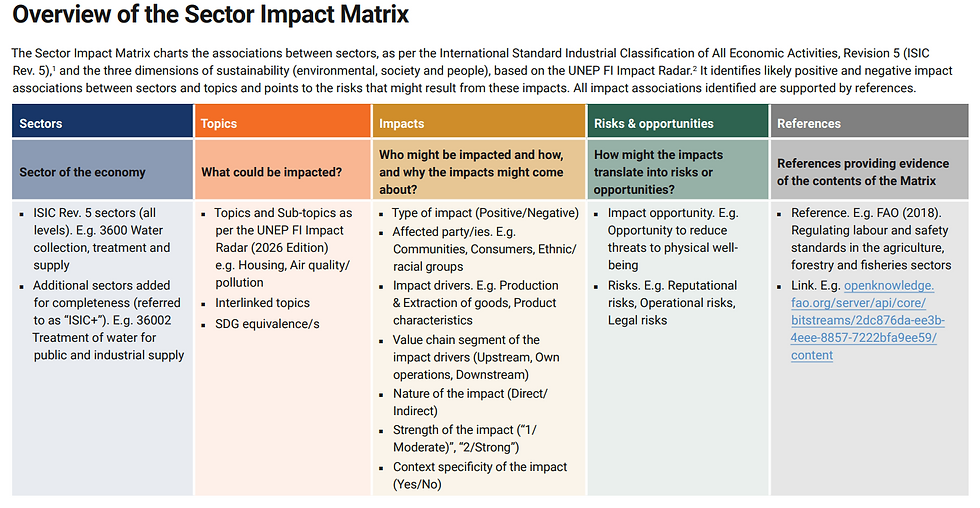
Relevant visual: Figure 1. Overview of the Sector Impact Matrix
A new place for animals in sustainability assessment
The Sector Impact Matrix is a sustainability impact identification tool developed by UNEP FI. It helps users identify the impacts commonly associated with different economic sectors, who or what may be affected, and the related risks and opportunities. The methodology supports activities such as impact and materiality assessments, due diligence, sustainability strategy development, and portfolio analysis.
The 2026 edition now includes a dedicated Animals category within the broader Society grouping. UNEP FI identifies five groups (or affected party sub-categories) of animals:
Animals raised for food
Animals used in fashion
Animals used in research and testing
Animals used for entertainment
Companion animals
Relevant visual: Figure 2. UNEP FI Impact Radar

Relevant visual: Figure 3. UNEP FI’s affected-party framework includes Animals as a distinct category

Animal welfare is now a recognized sustainability topic
The 2026 Impact Radar reinforces this development by including animal welfare as a standalone sustainability topic. UNEP FI notes that animal welfare had been a gap in previous editions of the framework.
UNEP FI defines animal welfare as:
“Society's ability to ensure that animals are treated humanely, protected from harm and able to live in conditions that support their health, comfort, nutrition, safety and the expression of natural behaviours.”
The Impact Radar also describes animals in human-managed contexts as part of society and socio-economic systems. Wildlife-related impacts may also be reflected elsewhere in the methodology through the Natural Environment category, which refers to "living beings" as components of nature.
Together, these changes provide a clearer basis for considering animal-related impacts within sustainability assessments and decision-making processes.
Why this matters for farmed animals
For the FARMS Initiative, the explicit recognition of animals raised for food is particularly important.
Farmed animals are affected by decisions made throughout food and agricultural value chains, including production systems, housing, breeding, transport, handling, and slaughter. Yet animal welfare has not always been explicitly reflected within sustainability impact assessment methodologies.
By recognizing animals as affected parties and animal welfare as a sustainability topic, UNEP FI's updated framework creates a clearer pathway for animal-related impacts to be considered alongside other sustainability impacts associated with food and agriculture.
The Matrix does not determine whether a particular farming practice is acceptable, nor does it assess the welfare performance of individual companies. Instead, it serves as a starting point for identifying the types of impacts commonly associated with different sectors and activities. UNEP FI notes that users should supplement the methodology with company-specific information, geographic context, due diligence findings, and other relevant evidence.
Example: Pig production in the Sector Impact Matrix
The updated methodology is already being applied to specific industries. For example, the Matrix identifies raising of swine and pigs (ISIC 0145) as having a potential negative impact on animal welfare. UNEP FI notes that intensive husbandry practices, confinement systems, transport conditions, and handling methods may cause stress, injury, and compromised health outcomes for animals.
In this example, the affected party sub-category is identified as animals raised for food, the impact is classified as occurring within an organization's own operations, and the methodology highlights opportunities to reduce harm to animals. The Matrix also notes that poor animal welfare practices may create reputational and legal risks for organizations.
What could this mean in practice?
The Sector Impact Matrix is intended for use by financial institutions, companies, consultants, data providers, policymakers, regulators, standard setters, and civil society organizations.
For financial institutions, the methodology can help inform:
Materiality and impact assessments
Due diligence
Portfolio analysis
Client and investee engagement
Sustainability strategy development
Risk and opportunity analysis
The inclusion of animals does not require organizations to assess animal welfare or change financing and investment decisions. The Matrix is a voluntary methodology, not a regulation, reporting standard, certification scheme, or company assessment tool.
Its significance lies in providing a recognized framework through which animal-related impacts can be identified and considered. Over time, that visibility may support broader discussions around corporate animal welfare policies, engagement expectations, due diligence, disclosure, responsible investment, and sustainable finance approaches.
Recognizing animals is a step forward
Recognizing animals as affected parties and animal welfare as a sustainability topic will not, by itself, improve outcomes for animals. However, it creates a stronger foundation for animal-related impacts to be identified and considered alongside other sustainability impacts.
For the FARMS Initiative, this represents an important step toward ensuring that the welfare of animals raised for food is recognized as part of the broader sustainability impacts associated with food and agricultural systems.
The FARMS Initiative will continue to engage with financial institutions and other stakeholders to advance the integration of animal welfare into sustainability and sustainable finance.


